Cold Chain Case Studies
Real-world research. Proven results. Dive deeper into the cold chain process and discover why cold chain systems fail, and how industry-leading solutions from Optimyz℠ protect what matters most.
Identifying the Lockbox as the Weak Link in Specimen Transport Cold Chain
A Field Study on Temperature Traceability in Physician-Office Lockbox Collection
In diagnostic logistics, every hour and every degree matters.
Background
Most diagnostic laboratories in the United States rely on lockboxes as the first link in their specimen collection network. Physician offices deposit temperature-sensitive samples during business hours, and a courier retrieves them later in the evening. The model depends on cold packs or other coolants being properly placed inside the lockbox ahead of drop-off. It is a step that is instructed but rarely verified.
Without verification at the point of use, the lockbox becomes a blind spot in the cold chain: the one point where a specimen can sit unmonitored for hours before pickup, with no record of whether it was ever within a safe range.
The Problem
When lockboxes are not conditioned correctly, or the cooling equipment underperforms, specimens are exposed to thermal excursions that can compromise sample integrity. This is not merely an operational inefficiency, it is a clinical risk. Compromised samples can delay diagnoses, affect patient outcomes, and drive up costs through re-testing or re-collection. Until now, most labs have had no way to know whether an excursion happened, when it happened, or which lockbox was responsible.
Methodology
Akuratemp’s Optimyz team deployed Bluetooth-enabled temperature sensors across eight lockbox locations along a live medical courier route. Each lockbox was tagged with a QR code, scanned by the courier at the time of pickup using the Akurasense Connector App, already installed on their Android devices running the labs LIMS software tracking the courier route and specimens. Each scan synced time & geolocation stamped temperature data at the time of pickup, giving continuous visibility over a five-day monitoring period. The operator’s SOP specified an acceptable storage range of 1°C to 10°C.
Results
Lockbox Process Capability Summary (n = 839 readings):
12.6°C
Average Temperature
5.26°C
Standard Deviation
29.7%
Within SOP Range
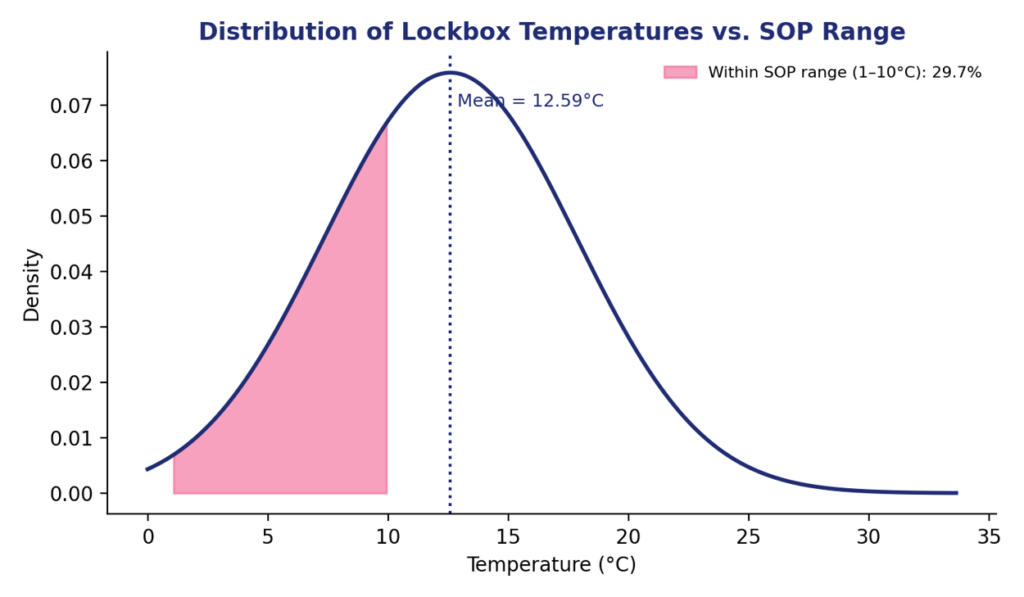
The results were unambiguous: most lockboxes failed to maintain safe temperature conditions over the monitoring window. This points to a systemic gap in thermal protection and monitoring across the collection chain, not an isolated equipment failure.
Temperature by Lockbox
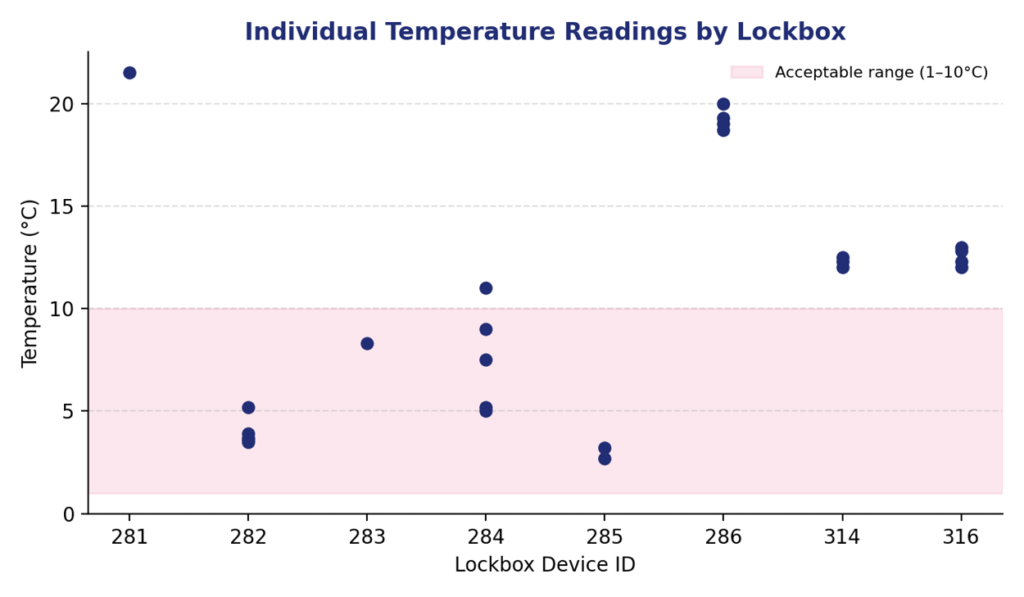
Performance varied sharply by unit. Lockboxes 282 and 285 stayed consistently within range, while Units 281, 286, 314 and 316 recorded persistent excursions well above the 10°C threshold. This spread is itself the key finding: failure was not inherent to the lockbox model, but traceable to individual units, locations, and conditioning practices.
Key Finding
With over 70% of readings falling outside the validated range, the data identifies the lockbox, not courier transit or lab receiving, as the weak link in the specimen cold chain. Because each reading was tied to a specific device, timestamp, and location, the failures are traceable to a specific unit and pickup event rather than treated as an unavoidable cost of the model. What the data spread indicates:
- Lockbox 282 and 285 were consistently conditioned as per protocol and performed to requirement.
- Lockbox 284 was conditioned per protocol 3 time out of 4.
- Lockbox 314 and 316 were conditioned but not per protocol.
- Lockbox 281 and 286 were not conditioned at all.
The Fix: Traceability at Drop and Pickup
The path forward is not replacing the lockbox model, it is instrumenting it. By logging temperature at both specimen drop-off and courier pickup, collection sites gain a verifiable record showing whether the lockbox was properly conditioned before a specimen was ever placed inside, rather than a single snapshot at retrieval.
- Confirm conditioning before drop-off, not just after the fact
- Create a timestamped, geolocated record for every specimen pickup
- Shift accountability upstream to the collection site, where the excursion originates
- Flag underperforming sites workflow training before they impact patient samples
Conclusion
Lockboxes will remain a fixture of diagnostic specimen collection, but they can no longer be a blind spot. Continuous, geolocated temperature monitoring, paired with a conditioning-verification step at drop-off, can turns an unmonitored liability into a traceable, correctable part of the cold chain.
The Optimyz℠ Team

Harshul Gupta
As Co-Founder and CTO of Akuratemp LLC, Harshul supports the cold chain infrastructure that healthcare, diagnostics, and life sciences companies rely on. With 18+ years in engineering, manufacturing, and business operations, backed by MSEE, MPM, LSS Green Belt, and Certified Internal Auditor credentials, Harshul’s focus is on advancing supply chain reliability, sustainability, and traceability.