Vehicle-Mounted Freezers: Traceability for the Frozen Specimen Leg of the Cold Chain
A Field Study on Temperature Variability in Vehicle-Installed Chest Freezers
Background
Transporting frozen samples between collection sites to central laboratories is one of the most technically demanding aspects of the diagnostic cold chain. When physician-office collections include frozen specimens, those samples must be frozen immediately after collection, packed correctly with ice pack and placed into lockboxes. From there, the burden shifts to medical couriers, who are responsible for maintaining the frozen state during transport, often using dry ice in their totes.
As specimens move from lockbox, to courier tote, to vehicle-mounted freezer, and sometimes into a larger portable cooler for the final leg, each handoff is another point where the frozen cold chain can break and another asset whose temperature history needs to be traceable, not assumed.
To meet the demands of frozen transport, some advanced laboratory courier operations have installed freezer chests directly inside courier vehicles. These units are powered by the vehicle’s electrical system, on the premise that as long as the engine is running, the freezer stays operational and protects the frozen samples until they reach the diagnostic lab. In theory, this closes a key gap in the cold chain. But what happens when theory meets real-world courier routes?
Methodology
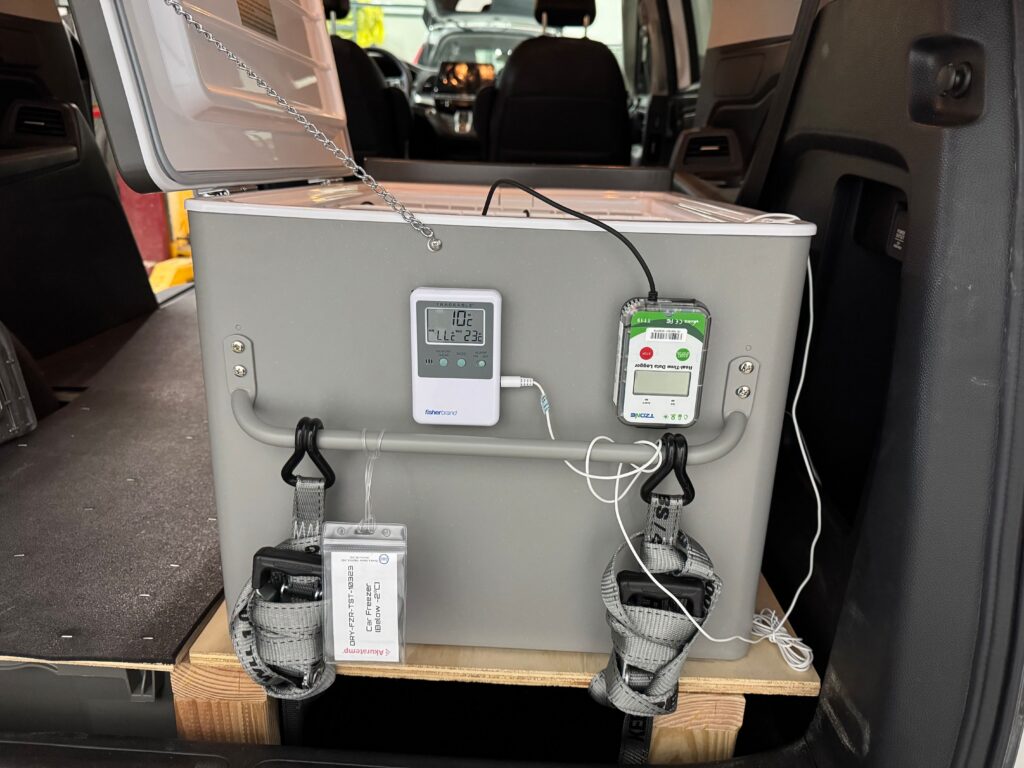
To evaluate the real-world performance of vehicle-installed freezers, the Akuratemp’s Optimyz team conducted a multi-day field study using 4G-enabled temperature sensors with time and geolocation stamp. Four courier vehicles were outfitted with sensors placed inside their freezer units. Each courier operated a distinct route but repeated the same route daily to maintain consistency in the data. Time-stamped temperature readings were matched with geolocation data to trace excursions back to specific stops along each route.
Results
Recovery Time After Excursion
Stop Length That Triggered a Spike
Target Pre-Cool Temperature
Key Findings
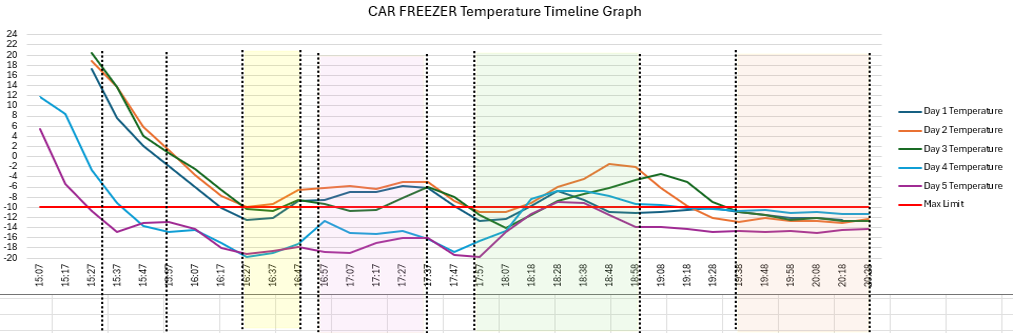
- Freezer temperatures rose rapidly during prolonged vehicle stops.
- After crossing the critical −10°C threshold, it took at least 30 minutes of continuous driving to return to acceptable levels.
- Stops longer than 10 minutes resulted in immediate internal temperature spikes.
- When freezers were not pre-cooled to −18°C before starting, even short idle periods pushed temperatures above safe limits.
- Some routes didn’t allow enough pre-drive time for the freezer to reach optimal temperature before the first pickup.
Root Causes Identified
- Vehicles were launched before the freezer reached −18°C.
- Drivers turned off the engine, disabling the freezer, during deliveries or breaks.
- Couriers opened the freezer door while the unit was off, allowing a surge in internal temperature.
Why Traceability Matters
These excursions were not only frequent but invisible without real-time monitoring. This presents a major risk: frozen samples may thaw unknowingly, compromising specimen integrity, delaying diagnostics, or leading to costly re-collections. A reliable traceability system is not just a regulatory or quality assurance requirement. It’s a safeguard for clinical reliability and courier accountability.
This is true of every asset a frozen specimen touches on its way to the lab, not just the vehicle freezer. Portable coolers used for longer final-mile legs carry the same risk: once a specimen is transferred out of a monitored freezer and into an unmonitored cooler, the traceable record breaks exactly at the point where a new excursion is most likely to begin.
The Fix: Continuous, Geolocated Monitoring at Every Asset
- Confirms the freezer has reached −18°C before a route begins, not after the first pickup is already missed
- Flags engine shutoffs and door-open events that disable cooling, tied to a specific stop
- Ties temperature excursions to route geolocation, so root cause is identifiable rather than assumed
- Extends the same traceability to portable coolers used for onward transport, so no handoff in the frozen chain is a blind spot
Conclusion
Together with the lockbox and courier tote findings, this study confirms that frozen specimen transport carries its own, distinct point of failure: the vehicle-mounted freezer, and any portable cooler it hands off to. Closing the gap requires the same principle applied consistently across every asset in the chain — continuous, geolocated temperature monitoring from the moment a specimen is frozen to the moment it reaches the lab.