Cold Chain Case Studies
Real-world research. Proven results. Dive deeper into the cold chain process and discover why cold chain systems fail, and how industry-leading solutions from Optimyz℠ protect what matters most.
Medical Courier Totes: The Second Weak Link in Specimen Transport Cold Chain
A Field Study on Temperature Performance in Real-World Courier Totes
In the diagnostic cold chain, every degree and every hour counts.
Background
Across the United States, diagnostic laboratories rely heavily on medical couriers to collect and transport patient specimens. often from physician-office lockboxes or regional labs to centralized testing facilities. The effectiveness of patient care often hinges on the reliability and temperature control of this last-mile logistics network.
Typically, couriers use insulated totes equipped with cold packs for frozen and refrigerated samples, with separate compartments often external pockets for ambient samples. These totes are generally kept in air-conditioned vehicles, offering a degree of thermal protection. However, the real-world performance of these courier totes is rarely validated, and they are repeatedly opened during daily multi-stop routes, creating conditions ripe for thermal excursions.
The Hidden Risk in the Diagnostic Supply Chain
While most labs provide instructions for handling temperature-sensitive specimens, including the use of cold packs, compliance in the field is inconsistent. Couriers face practical challenges: limited space, time pressure, inadequate training, and variations in tote quality and cold pack conditioning. These small gaps in process control can lead to temperature instability. It is a silent but significant risk that can compromise sample integrity, delay diagnosis, and increase costs through re-collection or re-testing.
This isn’t just a logistical issue, it’s a clinical risk. Medical couriers are often caught in the middle, unknowingly transporting samples that may no longer meet thermal requirements, increasing the risk of mishandling without any immediate visibility into the breach.
Methodology
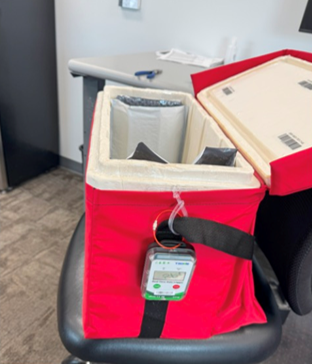
To better understand this risk, the Akuratemp’s Optimyz team conducted a field study using real-time, 4G-enabled time & gelocation stamped temperature sensors placed inside courier totes across three routes. Each courier followed a fixed daily route, and all totes were packed using the same standard conditioning practices. Sensors logged internal tote temperature continuously across multiple days per route.
Results
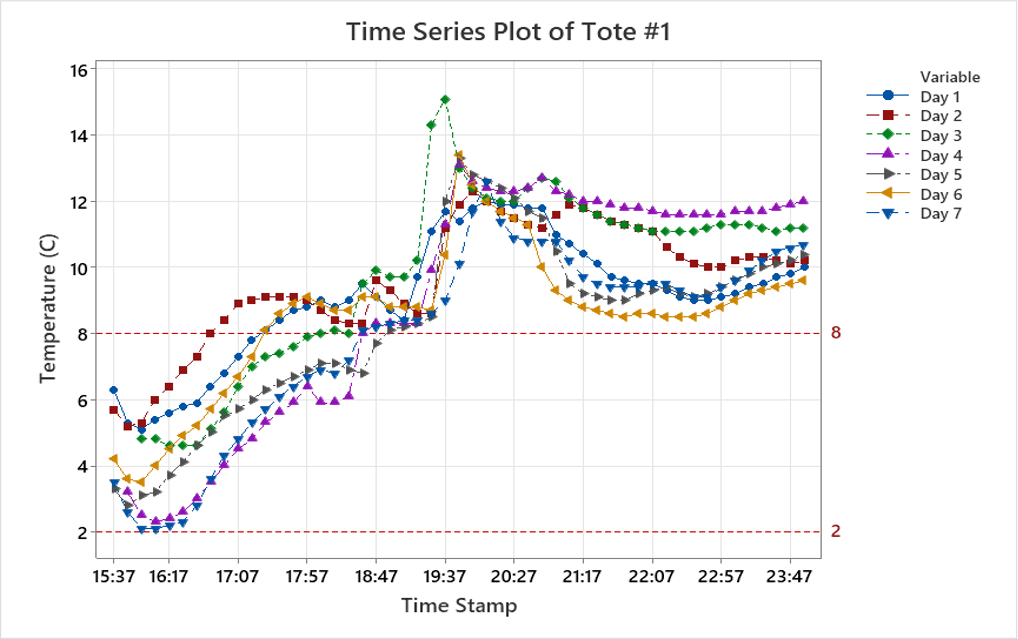
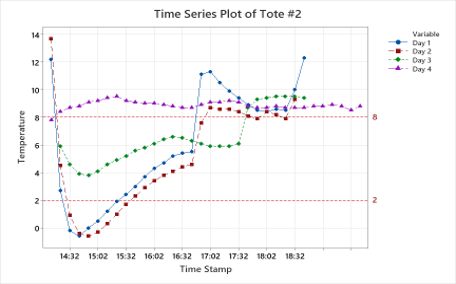
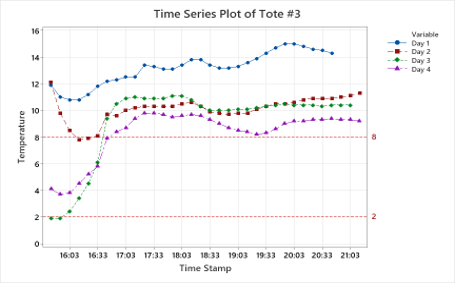
Figure 1. Time-series temperature readings inside Totes 1–3 across multiple days on each courier’s route. Red lines mark the SOP min/max (2°C–8°C). All three totes climb out of range within the first couple of hours and stay elevated for the remainder of the route.
~2 hrs
Time Within Target Range (≤8°C)
12–16°C
Steady-State Temperature Reached
Key Findings
- The internal temperature of the courier totes remained within the target range (≤8°C) for only ~2 hours after route start.
- After that, tote temperatures consistently rose and stabilized between 12°C and 16°C, well above the acceptable threshold for refrigerated samples.
- This pattern held across multiple days and couriers, pointing to systemic issues rather than isolated incidents.
Root Causes Identified
- Inadequate conditioning of cold packs
- Suboptimal number or placement of cold packs within the tote
- Poor insulation performance of the cooler
- Frequent and prolonged lid openings at each pickup point
Key Finding
Courier totes are marketed and validated for a 2°C–8°C refrigerated range, but in real-world, multi-stop use they hold that range for only a fraction of the route. The excursion isn’t a one-off failure, it’s a consistent, predictable drift that repeats across couriers and days, meaning it is a design and process gap rather than an isolated incident.
The Fix: Monitoring and Verification Across the Tote's Route
As with the lockbox, the answer is not to abandon the tote model but to instrument and verify it. Continuous temperature logging inside the tote, not just a spot-check at pickup or drop-off. makes the excursion visible in time to act on it, rather than after a specimen has already spent hours out of range.
- Confirm cold pack conditioning and placement before a route begins
- Flag totes with poor insulation performance for replacement
- Create a timestamped record tying temperature drift to specific stops and lid-opening events
- Provide couriers real-time visibility instead of an after-the-fact discovery at the lab
Conclusion
Together with the lockbox findings, this study shows that the specimen cold chain has more than one weak link, the courier tote is a second, equally systemic point of failure. Closing both gaps requires the same fix: continuous, traceable temperature monitoring at every handoff, from drop-off, to pickup, to final delivery.
The Optimyz℠ Team

Harshul Gupta
As Co-Founder and CTO of Akuratemp LLC, Harshul supports the cold chain infrastructure that healthcare, diagnostics, and life sciences companies rely on. With 18+ years in engineering, manufacturing, and business operations, backed by MSEE, MPM, LSS Green Belt, and Certified Internal Auditor credentials, Harshul’s focus is on advancing supply chain reliability, sustainability, and traceability.